
“The world is so vast and so small at the same time. Travel makes texts come alive.”
A homeschool parent wrote those words in a discussion I recently joined, and they perfectly captured something I’ve been reflecting on.
The question was simple:
Do you believe travel teaches more than textbooks?
The responses were passionate.
Some parents said life experience is the ultimate teacher. Others argued that books provide the foundation children need before they can understand the world around them.
As I read through hundreds of comments, I realized something important:
The most effective education has never been about choosing one over the other.
It is about understanding how they work together.
The Problem With “Either/Or” Thinking
Modern education often encourages us to separate learning into categories.
School learning.
Life learning.
Book learning.
Real-world learning.
Yet children do not experience life in neat little boxes.
A child reading about farming may learn vocabulary, concepts, and definitions.
A child visiting a farm hears the animals, smells the hay, watches the work, asks questions, and sees the entire system functioning together.
Both experiences matter.
One provides information.
The other provides context.
When combined, they create understanding.
Books Give Us Roots
As a homeschool mother and curriculum creator, I will never dismiss the value of books.
Books teach:
- Reading comprehension
- Writing skills
- Mathematics
- History
- Research
- Critical thinking
Books allow us to learn from people we may never meet and places we may never visit.
They preserve knowledge across generations.
In many ways, books are root chakra energy.
They provide stability.
Structure.
Foundation.
Without roots, growth becomes difficult.
Experience Gives Learning Life
At the same time, there are lessons that cannot be fully understood from a page.
Compassion.
Adaptability.
Cultural awareness.
Communication.
Observation.
Confidence.
These are often learned through experience.
A trip to a museum can transform history from dates and names into real human stories.
A visit to a local market can become a lesson in economics, nutrition, geography, and communication.
Even something as simple as opening a savings account can teach financial literacy in ways a worksheet never could.
Travel doesn’t have to mean airplanes, hotels, and expensive vacations.
Sometimes travel means driving across town.
Sometimes it means visiting a park.
Sometimes it means exploring your own neighborhood with fresh eyes.
The goal is not distance.
The goal is exposure.
The Inner-G Learning Loop
While developing the Inner-G Scholars Academy curriculum, I realized that meaningful learning tends to follow a simple pattern.
Learn. Read the lesson. Study the concept. Gather information. Experience
Observe it in real life. Visit it. Explore it. Interact with it. Reflect. Journal about it.
Discuss it. Ask questions. Consider different perspectives. Apply. Use the knowledge.
Create something. Solve a problem. Share what was learned. This cycle transforms information into wisdom.
Why Real-World Learning Matters
The world our children are inheriting is changing rapidly.
Facts are available instantly.
Information is everywhere.
The real challenge is helping children understand what to do with that information.
Can they think critically?
Can they communicate effectively?
Can they adapt?
Can they recognize patterns?
Can they empathize with people whose experiences differ from their own?
Those skills are often developed when learning moves beyond the page.
A Full Moon Reflection
As we approach the Full Moon, I find myself reflecting on a different question.
Not whether travel teaches more than textbooks.
But whether our children are being given opportunities to connect learning with life.
Consider asking yourself:
- What experiences shaped my greatest lessons?
- What memories taught me more than a classroom ever could?
- How can I create more opportunities for meaningful learning this month?
The goal isn’t perfection.
The goal is connection.
Final Thoughts
Homeschooling was never meant to be about recreating school at home.
It was meant to give families the freedom to learn differently.
To slow down.
To pay attention.
To follow curiosity.
To connect knowledge with experience.
Books matter.
Experiences matter.
Together, they create something powerful.
Because education is not simply about preparing children for tests.
It is about preparing them for life.
Journal Prompt
What is one experience from your childhood that taught you something no textbook ever could?
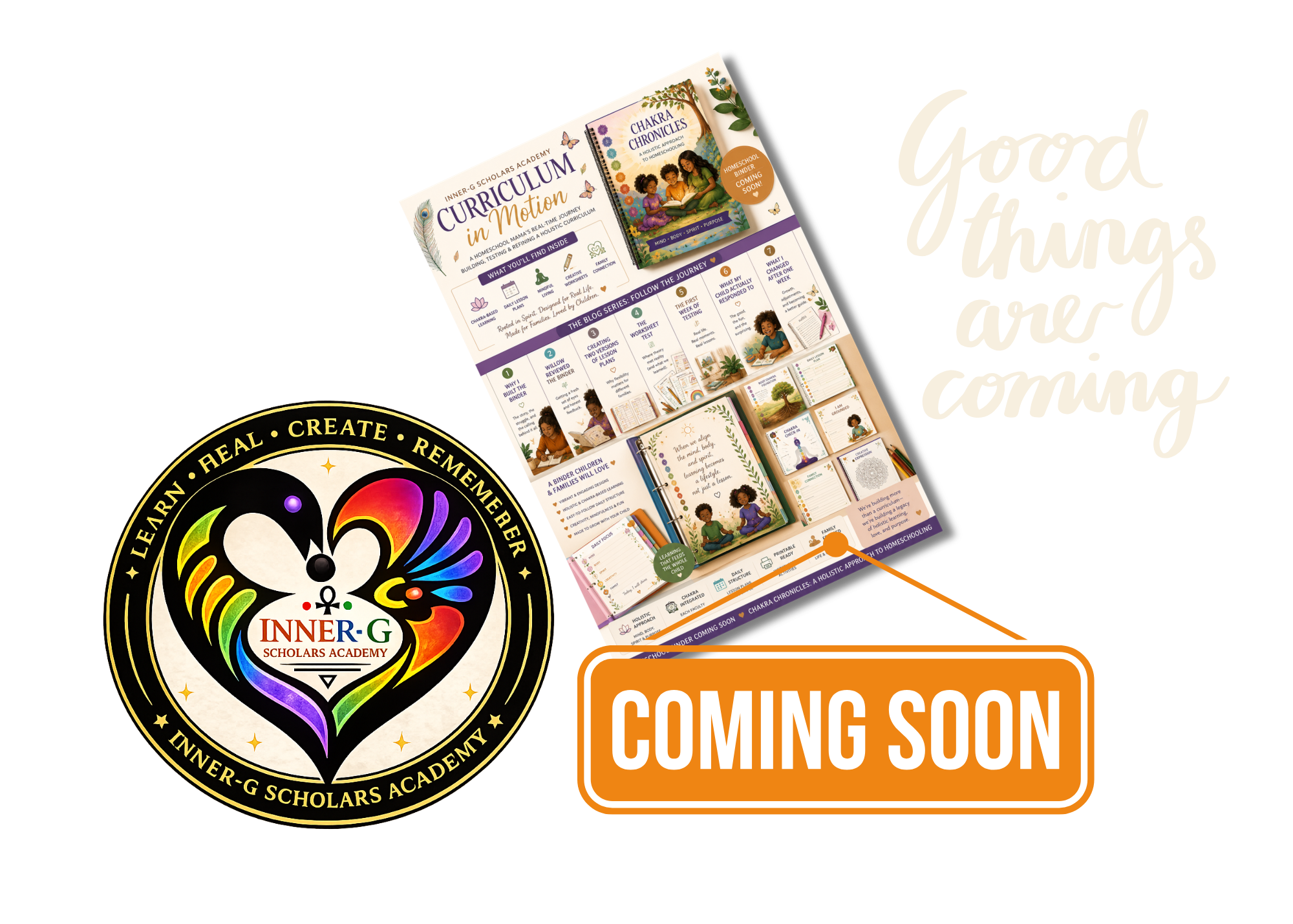
Coming Soon: The Inner-G Scholars Academy Homeschool Binder, a holistic approach to learning that combines academics, life skills, reflection, creativity, and real-world experiences into one intentional system.
 Something Nubian
Leave a comment