
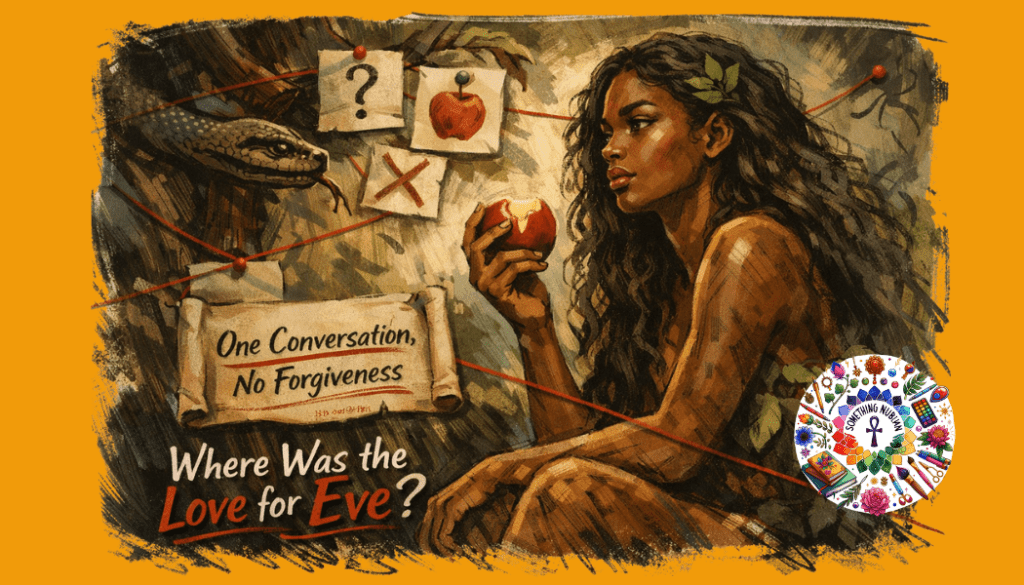
There was no body.
No blood.
No murder weapon logged into evidence.
Just a woman.
A conversation.
And a sentence that never expired.
This is a cold case, not because something went missing, but because forgiveness never arrived. In the oldest story told about women, the punishment outlived the moment, the context evaporated, and love never made it into the record. February is Heart Month. If we’re going to talk about love, let’s reopen the case that shaped how women are trusted, blamed, and remembered.
The Only Conversation
Here is the first receipt, plain and unembellished.
In Book of Genesis 3, the serpent speaks.
It speaks once.
It speaks only to Eve.
Nowhere else in scripture does a serpent engage a human in dialogue. Later texts reference serpents often, yes, but symbolically, poetically, theologically. They do not return to conversation. They do not persuade. They do not reason. The only exchange happens here, with a woman, in a garden, at the beginning of recorded spiritual memory.
That matters.
Not because Eve is special in guilt, but because she is singular in experience.
The Missing Context
The text tells us what Eve did.
It does not tell us:
- what her body needed
- what hunger meant in that moment
- what curiosity felt like before shame existed
- what discernment sounded like without fear attached
The fruit is never named. The word “apple” is a later cultural addition, not scripture. The narrative is sparse where women’s interior lives are concerned. That pattern repeats throughout the Bible. Women appear, act, and are judged, while their context is rarely preserved.
This isn’t a discrepancy. It’s an absence.
And absences shape interpretation just as powerfully as words.
The Aftermath
Here’s where the case turns.
Eve’s action becomes:
- the template for temptation
- the justification for mistrust
- the explanation for suffering
- the moral shorthand for why women must be watched
Adam eats the fruit too. That is not debated. But the cultural weight settles almost exclusively on Eve. Over time, her curiosity becomes deception. Her agency becomes weakness. Her humanity becomes a warning label.
This isn’t about rewriting scripture.
It’s about noticing how interpretation travels.
The Long Sentence
Centuries later, women are still paying into this account.
Still described as:
- emotional before rational
- persuasive before wise
- dangerous with knowledge
- responsible for restraint
And yet, no appeal process was ever introduced for Eve. No chapter closes with mercy. No divine pause says, I see you. The story moves on, but the reputation remains frozen in judgment.
That’s the real mystery.
❤️ Heart Month Reflection: Forgiveness as Missing Evidence
February asks us to reflect on love — not the performative kind, but the restorative kind. The kind that doesn’t need someone to be innocent in order to be human.
If forgiveness is a cornerstone of spiritual maturity, then its absence in Eve’s story deserves attention. Not to overturn scripture, but to question how compassion fell out of the conversation so early — and how that omission has echoed through generations of women since.
This is not about absolving responsibility.
It is about restoring proportion.
A Necessary Clarification (and a Loving One)
This reflection is not about Bible/male-bashing.
Men I love have also inherited this story in damaging ways. Asked to lead without tenderness. To judge instead of protect. To carry authority without emotional permission. Patriarchy didn’t just wound women; it recruited men into roles many never consented to.
This is not a war between genders.
It is an examination of a narrative that hardened where it could have healed.
🌿 The Real Verdict
No murder occurred in Eden.
No violence.
No malice recorded.
What was lost was quieter, and therefore easier to overlook:
- context
- compassion
- balance
- love
A woman made a choice, and the story moved forward without ever circling back to her humanity. The punishment lingered. The interpretation hardened. The grace never entered the record.
This wasn’t a failure of faith.
It was a failure of follow-up.
🕊️
Maybe the most radical spiritual question isn’t whether Eve was right or wrong.
Maybe it’s this:
Why was the first woman never allowed to be forgiven?
Not erased.
Not defended.
Simply seen — and released.
One conversation.
No forgiveness.
And a love story still unfinished.
🖊️ Journal Prompt: A Love Letter the Story Never Wrote
If forgiveness had been extended to Eve, what might have changed about how women are trusted today?
Reflect on a time when curiosity, hunger, or intuition was mistaken for wrongdoing in your own life.
What would it look like to offer yourself the grace that was never modeled?
Write a short letter — not defending yourself, but forgiving yourself — for knowing, choosing, or becoming.
Forgiveness doesn’t rewrite the story. It softens what history hardened.
— ReikiRaEss 🪬
Writer, healer, and sacred systems thinker
Exploring faith, femininity, and forgiveness through truth, tenderness, and inquiry
I don’t believe in God, because I know God. I share the same God as the planets and plants.
 Something Nubian
Leave a comment