
What We Learned About Love, Loyalty, and Safety Before We Ever Had a Say
January has a way of telling the truth quietly.
Not the loud, performative “new year, new me” kind of truth — but the kind that sits with you while you’re folding laundry, journaling half-awake, or watching the same patterns replay in your home, your relationships, and your work.
Before most of us ever chose how to love, how to commit, or how to stay — our bodies were already trained.
This isn’t a conversation about blame.
It’s about pattern literacy.
Because many of the struggles we see in adulthood — infidelity, emotional distance, overgiving, fear of commitment, people-pleasing, burnout — didn’t begin as moral failures.
They began as adaptations.
Love Was Learned Long Before It Was Chosen
For many melanated families, non-monogamy wasn’t always explained — it was absorbed.
Sometimes it showed up as:
- Love mixed with secrecy
- Loyalty spoken but not modeled
- Staying together “for the kids” while trust quietly eroded
- Affection paired with emotional absence
Children don’t just watch relationships.
They feel them.
So the nervous system learns early:
- Safety is inconsistent
- Intimacy comes with risk
- Having more than one attachment feels safer than relying on one
This doesn’t come only from fathers.
Mothers, survival strategies, silence, and unspoken rules teach just as loudly.
And yes — women cheat too.
Often not from desire alone, but from loneliness, emotional neglect, survival, or being taught to overextend without being met.
When children grow up watching adults maneuver around truth — voluntarily or involuntarily — monogamy doesn’t feel like a sacred container.
It feels like a story people tell, not a reality people live.
The Body Learned This Before the Mind Did
This is the part most conversations skip.
We don’t just think our way into patterns — we regulate our way into them.
When instability is familiar, calm can feel suspicious.
When chaos is normalized, consistency can feel boring or unsafe.
When love required endurance, peace can feel undeserved.
So when someone says, “Why can’t he just choose one woman?”
Or “Why can’t she just be satisfied?”
They’re asking the nervous system to override years of conditioning without tools, language, or healing.
Understanding this doesn’t excuse harmful behavior —
but it does explain why willpower alone doesn’t heal it.
How This Pattern Shows Up Everywhere (Not Just Romance)
This isn’t only about relationships.
It’s about how we move through life.
In the Home
Children learn safety through consistency, not speeches.
What feels “normal” becomes their baseline.
In Marriage & Partnership
Love exists — but so does an exit plan.
Walls are built with windows and back doors “just in case.”
In Business
Overgiving. Undercharging. Fear of being seen.
Burnout disguised as loyalty.
In Homeschooling & Learning
Teaching values without modeling regulation.
Expecting emotional maturity without emotional safety.
In Journaling & Healing
Writing the same realizations over and over
without integration or embodied change.
Different arenas.
Same pattern.
This Is Where the Cycle Can Stop
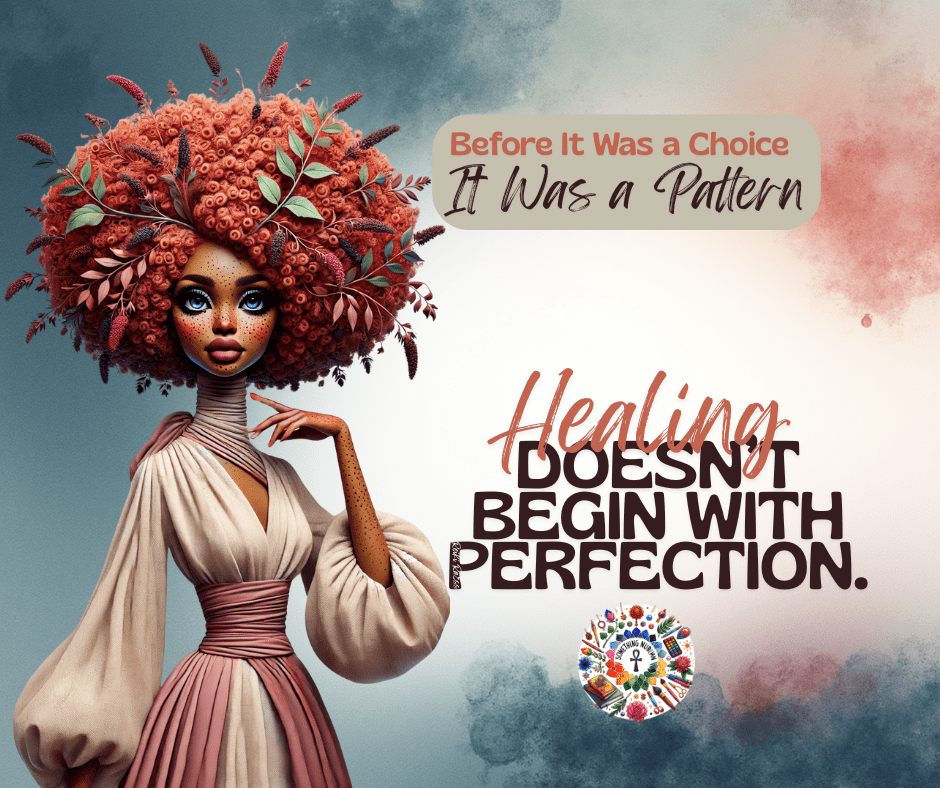
Healing doesn’t begin with perfection.
It begins with awareness without shame.
Cycle-breaking isn’t dramatic.
It’s daily.
It’s boring sometimes.
It’s choosing honesty when silence feels easier.
It’s choosing regulation over reaction.
It’s choosing to model what you didn’t receive.
At some point, someone says:
“This stops with me — not because I’m better, but because I’m aware.”
That person becomes the interruption.
Reflection (Pause Here)
Take this to your journal, planner, or quiet moment:
- What did love feel like in my childhood home?
- What behaviors were normalized but never named?
- Where do I see those patterns repeating in my relationships, work, or parenting?
- What does safety look like in my body — not just in theory?
Write without fixing.
Notice without judging.
A Practice for This Season (January Medicine)
For the rest of this season:
- Choose consistency over intensity
- Choose truth over performance
- Choose modeling over lecturing
- Choose regulation over reaction
Whether you are:
- Homeschooling children
- Building a business
- Holding a marriage together
- Or healing yourself quietly
The work is the same.
We don’t heal by pretending we didn’t learn these patterns.
We heal by learning them consciously — and choosing differently.
Patterns are inherited.
Healing is chosen.
And January?
January is where the choice begins.
Closing Note
This post begins a seasonal series on learned patterns, nervous system memory, and cycle-breaking in real life — at home, in love, in business, and in how we teach the next generation. This is actually the second into this series, the first one was published December 31st, last year.
If this resonated, stay close.
We’re going deeper.
Read slowly.
Pause often.
Let the body answer before the mind explains.
— Reiki RaEss
Guiding reflection, not reaction
Something Nubian


 Something Nubian
Leave a comment